
- MAP KEY
-
Broad Gauge 5'3" 1600mm Narrow Gauge 3’6” 1067mm Standard Gauge 4’8½” 1435mm The tracks are faded when the train service has ceased. Some of these tracks still have steel rails, while the sleepers and/or rails have been removed from others. Stock Routes Goyder's Line of Rainfall est. 1865 
Hundreds decl'd inside Line of Rainfall Hundreds decl'd outside Line of Rainfall CURRENT MAP Hundreds decl'd inside Line of Rainfall 
Hundreds decl'd outside Line of Rainfall 
History of Iron Mines & Tramways fromthe Middleback Ranges to Whyalla Dark Border
-
- ARTICLES
- GALLERIES
- MAPS
- CONTACT
"Land, capital and labour are the three grand elements of wealth; and the art of colonization consists in transferring capital and labour from countries where they are in excessive proportion to the quantity of fertile land, to countries where there is plenty of fertile land, but neither capital nor labour." John Stephens - The History of the Rise and Progress of the New British Province of South Australia 1839, a PDF of which (courtesy of Google Books) can be read and downloaded here.
1802 Matthew Flinders charted the southern coastline of Australia.
1830 Captain Charles Sturt took two longboats along the River Murray from the penal colony of New South Wales, through vast tracts of 'vacant' land and out through the Murray Mouth into the Southern Ocean, thereby 'discovering' South Australia.
This so-called vacant land of South Australia, unsold and not yet leased, but already with a spattering of squatters, was referred to in subsequent Parliamentary Acts regarding South Australian land as Waste Land, and the property of the British Crown.
Meanwhile, in 1829, Edward Gibbon Wakefield, convicted of eloping with an heiress and now alone in a Newgate prison cell, devised a plan for the systematic colonisation of some perfect but as yet undiscovered land. With the aid of Robert Gouger, he published the pamphlet: 'Sketch of a Proposal for Colonizing Australasia,' a PDF of which (courtesy of Google Books) can be read and downloaded here The basic principles of colonization which came to be identified as the "Wakefield theory" were as follows:
- Land should be sold at a fixed minimum price or above.
- The proceeds of land sales should be used primarily to subsidize the emigration of bona fide colonists.
- The volume and pace of emigration should be closely related to the amount of land available.
- Settlement should expand in contiguous blocks (the principle of "concentration").
- A large measure of local self-government in matters of selection of officials, land sales, emigration and revenue was essential.[This last clause was denied in the 1834 Foundation Act.]
The Foundation Act was passed by the British Government. A PDF copy of this Act can be read and downloaded here.
An excellent brief history of SA can be read here.
The site for Adelaide was chosen by Colonel William Light beside the River Torrens. Colonel Light completed the survey of Adelaide city centre and designed the city's grid layout. His plans and more information can be seen here and here
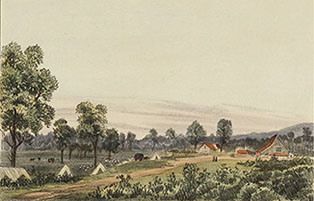
Adelaide,1837
Colonial lithograph of Colonel William Light's camp and the first settlement in Adelaide on the banks of the Torrens River.
In February 1850 a Private Act was passed authorising the construction of a railway by the Adelaide City and Port Railway Company to extend along the Port Road to Port Adelaide, with a branch to the North Arm. Under the Act, the Company was to have completed five miles of railway within eighteen months, with a gauge of 4 feet 8½ inches.
However, by October 1851 none of the line had been laid.
The Governor, through the Legislative Council, passed a further Act, (No. 1 of 1851) to appoint a Board of Undertakers to construct the Adelaide - Port Adelaide railway using Government funds. Under this Act five years was allowed for its completion and the gauge was to be Broad Gauge (5ft 3in) instead of the Standard Gauge (4ft 8½in) as originally proposed.
The first line to be laid with imported steel rails in Australia was a 10 kilometre broad gauge horse drawn tramway between the Murray River port of Goolwa and Port Elliot. This was opened on the 18th of May 1854.
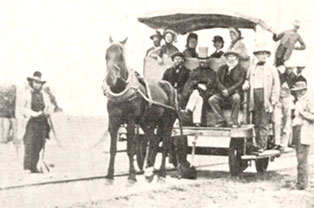
Tramway, Goolwa B44308 Courtesy SLSA
1854 The township of Port Augusta at the head of Spencer Gulf was surveyed.
1854 The township of Gambierton, later Mount Gambier was founded in the South East.
1854 The name Iron Knob first appeared on pastoral lease maps.
1855 James Macgeorge laid a telegraph line between Adelaide and Port Adelaide.
Pastoral land could now be held with an occupation license [also gives names of 1846 lessees and the situation of their Runs] which was replaced in 1851 with a 14 year Pastoral Lease.
By 1855 pastoral leases (not shown on these maps) were opening up vast tracts of the South East, and extended north into the southern Flinders Ranges and sections of Eyre and Yorke Peninsulas.
Current information and regulations regarding pastoral leases can be found here.
Following trial runs in February and March 1856, the State-owned Railways completed the 12km broad gauge Adelaide City - Port Adelaide railway.
Initially adopted by New South Wales, Victoria, South Australia and Tasmania, broad gauge tracks could carry trains at higher speeds and passengers in greater comfort than narrower gauges, but they were much more expensive to build.
Britain granted South Australia responsible government.
This locomotive displays the tender engine conversion conducted in 1869 [SLSA B 24]
Three locomotives, "Adelaide", "Victoria" and "Albert", were manufactured by Fairbairns in Manchester, England and imported to South Australia.
The Adelaide–Gawler railway line was opened
Following the granting of responsible government to South Australia, their new parliament passed the Waste Lands Act, setting conditions for sale of Crown Land and also cutting the tie between the land fund and Immigration which had been established by the British Crown in the Foundation Act, which stated that the British Crown:
" .... are hereby empowered to declare all the lands of the said province or provinces .... open to purchase by british subjects and to make such orders and regulations for the surveying and sale of such public lands at such price as the said commissioners may from time to time deem expedient .... and to employ the monies from time to time received as the purchase money of such lands or as rent of the common of pasturage of unsold portions thereof in conducting the emigration of poor persons from Great Britain or Ireland to the said province or provinces ...."
In January 1858 the Gawler Extension Railway Act (No. 10 of 1857-58) was passed to provide for the extension of the railway line from Gawler to Freeling and in December 1858, a further Act (Kapunda Railway Act, No. 2 of 1858) was passed to extend this railway to Kapunda where copper was first discovered in 1843.
By 1860 the railway had been built and Kapunda also soon became the State's largest wheat receiving station.
By 1860 land was generally sold only within the hundreds already proclaimed, thus regulating the spread of agriculture. It also became common to lay out at least one town in each hundred.
Part of the 1858 Stock Assessment Act stated: "which lands should be assessed at not less than one hundred sheep per square mile for the lowest class, nor more than two hundred and forty sheep per square mile for the highest class;"
1861 Copper was discovered at Moonta, on the Yorke Peninsula.
A private broad gauge horse-drawn tramway was built between Wallaroo and Kadina.
Port Elliot soon proved unsuitable for shipping and the railway line was extended to Victor Harbor in 1864.
The Wallaroo line was extended to Moonta.
Following a severe drought, Goyders Line, defining the area beyond which agriculture was not viable, was drawn. See more information about the Line here (opens in a new Tab).
The Scrub Lands Act was passed, designed to encourage farmers to settle on difficult mallee and scrub covered land.
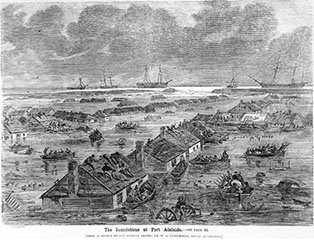
Flood at Port Adelaide, 1865
A tramway from Strathalbyn to Middleton was opened by the Governor, Sir James Fergusson on Tuesday 23rd February 1869.
The 'Strangways Act' was passed, proclaiming certain Hundreds as Agricultural (growing crops, requiring regular rainfall) rather than Pastoral (grazing sheep or cattle) Areas, thus opening up the Mid North to the Agriculturalists with their ploughs and seeders, to permanently destroy any remaining uneaten native vegetation.
Within these areas blocks of up to 320 acres were surveyed and sold on credit - 20 per cent of the price being paid at once as interest, and the principal being paid off at the end of four years. Each buyer was limited to 640 acres, and was required to reside on the land until purchase had been completed.
Prior to the Act settlers wishing to purchase land as agriculturalists rather than leasing land as pastoralists, were required to pay cash for the land, ownership of which which was then transferred to them from the British Crown.
After the Act settlers were able to buy their land on credit, thereby opening the prospect of land ownership to a far greater percentage of the population.
Coincidentally, there were a number of good rainy seasons, making land outside Goyder's Line appear to be viable, so land was surveyed and sold further and further north, as can be seen in the periods up to 1889.
It was during this period that the myth of rain following the plough arose.
The construction of the broad gauge Great Northern Line from Gawler to Burra was completed in 1869-70.
Influenced by Queensland Railway's successful adoption of the narrow gauge for cost reasons, South Australia changed the gauge of the Port Wakefield line to narrow gauge in the middle of construction, so the first narrow gauge line opened from Port Wakefield through Balaklava to Hoyleton. It was isolated from the broad gauge system and was originally a horse-drawn railway.
A number of isolated 3ft 6in gauge railways were constructed during the 1870s, inland from Port Augusta, Port Pirie, Port Wakefield, Kingston and Beachport. (See following maps for details of the new lines). These lines were designed to provide port facilities for their respective agriculture hinterlands.
The Port Broughton narrow gauge railway ran 16km to Mundoora to carry produce from the district to the export port of Port Broughton. It opened in around 1876 and was horse drawn up to 1926 when a little tractor was bought for it. It finally closed in 1942
A narrow gauge line was completed from Kingston to Naracoorte, via Lucindale.
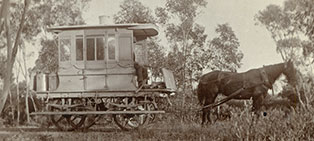
The Flying Scotchman Tramcar which ran between Mundoora and Port Broughton from March 11 1876. The tramcar was also known as the Pie Cart. The horse drawn carriage ran on rails. Courtesy SLSA
The invention of the stump-jump plough made cultivation of mallee country practicable, particularly on the Yorke Peninsula.
Working drawing of the first Stump Jump Plough [SLSA PRG 432/4/1]
1877 The copper mines at Burra and Kapunda closed.
The Port Wakefield to Kadina narrow gauge line was opened and continued to Wallaroo adjacent to the broad gauge line.
The Kapunda line was pushed through to Morgan to capture Murray River paddle steamer trade from upstream and thus any hope that Victor Harbor might become an important harbour for overseas ships was curtailed.
The narrow gauge railway reached Jamestown in 1878 when it was connected with Port Pirie, the first train arriving on 25 June.
Another narrow gauge railway was built from the port on Rivoli Bay (now Beachport) inland via Millicent to Mount Gambier in 1878

PROVINCIAL TELEGRAMS.
OPENING OF JAMESTOWN RAILWAY. Jamestown, June 25, 1878.
The first train of eleven goods trucks arrived here at 10.45 this morning. The Mayor of Port Pirie, the resident engineer (Mr. Chapman), the contractor, and several other gentlemen were passengers. A short adjournment was made to the Globe Hotel, where congratulatory speeches were made, and toasts drunk in bumpers of champagne. The train returned at 11 o'clock. The line runs very smoothly..
The narrow gauge line from Port Augusta reached Quorn in December 1879.
The Kadina junction to Snowtown opened.
Broad gauge lines reached Terowie.
The narrow gauge branch from Balaklava to Hamley Bridge was opened on 15 January 1880, creating the state's first break of gauge.
On 14 December 1880 the connection from Jamestown to Yongala was opened and a month later Jamestown people could also travel by train to Peterborough.
On 21 September 1881, the first section of a line opened from Naracoorte to Tatiara, now known as Wolseley.
Drought ruined thousands of farmers on marginal land in the Mid North and Goyder's Line was then definitively recognised as the limit for agriculture, although these maps show how far agriculture had already progressed outside the line.
There is a link to Dr. John C. Ratcliffe's excellent Overview of land development and agriculture in SA here.
 1882
1882
By the late 1870s the proposed railway [to Farina] was popularly viewed as the first section of a transcontinental railway to link Port Augusta with Darwin (then known as Palmerston).
A narrow gauge line was built from Peterborough, south to Terowie, and north through Orroroo to Quorn. However, although the line was technically completed in 1882, trains started running in 1881. There was a small gap from Orrorroo to Eurelia that was bridged by a road coach until mid 1882.
Terowie, in the state's mid-north, was the second site selected to become a 'break of gauge' station on the basis that coal and wool from the north and east could be carried via broad gauge to the processing and marketing facilities at Port Adelaide, whilst grain could be carted on the narrow gauge to Port Pirie, the nearest coastal port. Coal was therefore transferred from narrow gauge wagons to broad gauge wagons at Terowie.
Railway Yards and Station at Carrieton
SLSA B15166
1883
By May 1883, rail construction had not yet been completed, but trains were able to operate regularly from Bordertown on the Adelaide line and from Custon on the Mount Gambier line, continuing through Naracoorte to Kingston.
The great Northern Line was extended from Quorn to Hergott Springs (Marree).
The broad gauge South Line reached Nairne through the Adelaide Hills.
The Wilmington railway line opened from Gladstone to Laura on 2 June 1884.
Until 1884, trains south of Strathalbyn were hauled by horse power, but between 1883 and 1885 the section to Currency Creek was rebuilt to steam railway standards.
The Milang railway line, a branch line from the Victor Harbor to Strathalbyn railway, opened from the mainline at the farming locality of Sandergrove, 9 km south of Strathalbyn. From there it proceeded in a south-easterly direction for 13.1 km to the riverport of Milang on Lake Alexandrina, in the estuary of the River Murray.
The line was opened on 17 December 1884, the same day the upgraded Strathalbyn-Goolwa section was opened for steam-hauled instead of horse-drawn trains.
The connection from Adelaide reached the town in 1884, completing the link.
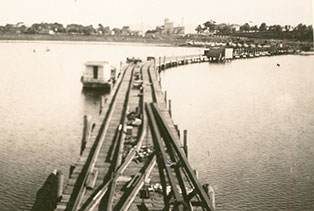
Milang jetty was built in 1856 and was increased in length twice more. The Port of Milang declined in importance after the line to Morgan in 1878 took away the upper Murray trade. This photograph shows rail tracks on the jetty, which dates the photograph after 1884.
SLSA B 11545
The main line to Melbourne was started after a bridge was built at Murray Bridge in 1886. It was the first railway line between colony capitals to not have a break-of-gauge. It was also the last of these to be converted to standard gauge in 1995.
Naracoorte was joined to Mount Gambier on 14 June 1887. There was a break-of-gauge junction at Wolseley.
Railways of South Australia and Victoria met at Serviceton.
Tunnel at Murray Bridge
B61793
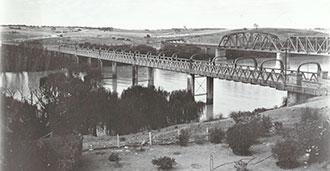
The new bridge behind the old bridge at Murray Bridge
PRG-1258-2-1845
Station at Murray Bridge
B10191
The narrow gauge line from Port Pirie was extended (in 1887/8) through Peterborough to Cockburn on the N.S.W. border.
Lead smelters were built at Port Pirie.
SLSA B8892/498
Narrow gauge 36T Class204 arriving at Port Pirie with ore train from Broken Hill
To serve the mining and pastoral industries in the far north of the state, the Great Northern Railway had been built from Port Augusta to Quorn in 1879, with the line reaching Marree in 1883. It now reached Oodnadatta in 1891.
Between 1888 and 1891, there were 34 applications to mine in the area south of Corunna Station, which is 6km north of Iron Knob.
The discovery of silver underneath a cap of iron ore at Broken Hill probably spurred a renewed interest in Iron Knob in the belief that a similar deposit existed there.
The Iron Monarch Company sank several shafts near Iron Knob but only found copper.
The main Stock Routes were derived from from records that accompanied a report by the Engineer-in-Chief on 30th June 1892. The original map can be seen under the tab marked 'Maps'
The Snowtown line was extended to Brinkworth, joining the Hamley Bridge-Gladstone railway line.
The Pinnaroo railway line was opened.
The first stage of Eyre Peninsula Railway opened from Port Lincoln to Cummins.
This narrow gauge railway on the Eyre Peninsula of South Australia, was built in order to encourage agricultural settlement. Radiating out from the ports at Port Lincoln and Thevenard, it is isolated from the rest of the South Australian railway network. Peaking at 777 kilometres in 1950, today only one 60 kilometre section remains open
1897 The first mineral claim in the area of Iron Knob was pegged by the Broken Hill Proprietary Company.
In 1899, BHP was granted a lease to mine iron ore from the Middleback Ranges.
1900 Mining commenced.
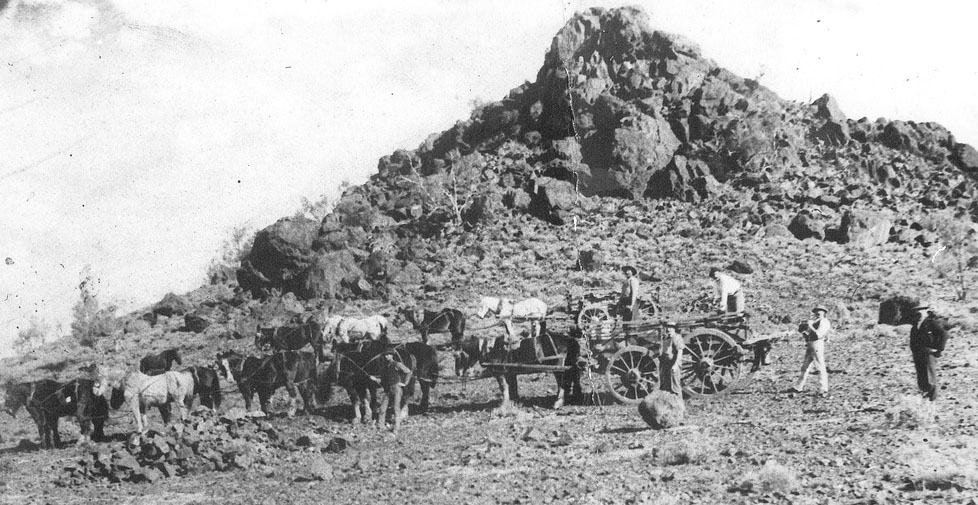
B-62485 Courtesy SLSA
Iron ore was first transported by bullock wagon to Port Augusta, where it was loaded on to 200-ton barges.
1901 Whyalla, then known as Hummock Hill, was founded on the upper Spencer Gulf as a port for iron ore from the Middleback Ranges.
The Hummock Hill to Iron Knob Tramways and Jetties Act 1900 authorised BHP to build a 54 kilometre line from Hummock Hill to Iron Knob that opened on 28 August 1901.
The ore was initially used at Port Pirie as a flux during the smelting of silver, lead and zinc ore.
At one time the Iron Knob and Iron Baron mining operations supplied the iron ore for all BHP blast furnaces, but since the development of the Pilbara deposits in WA, by 1966 the local mines have concentrated on fulfilling Whyalla's needs.
1902-1905 A railway having been constructed through a belt of fertile soil beneath the dense mallee from Tailem Bend to the Victorian border, by 1908 all the surveyed land within ten miles of the railway was occupied.
The 1902 Closer Settlement Act provided for the government to revert potentially good arable land away from the broad-acre pastoralists, buying any improvements (houses, wells, fencing, sheds). This land was then divided into farm lots and allotted on perpetual lease, the lessors buying the improvements from the Government over a period of 21 years at 4%. The rent was 4% of the value of the land and, in addition, the lessor was committed to spend 6% of the land value on improvements for the first 5 years (from which the value of the improvements they had purchased when taking over the block was deducted).
1903 Iron ore was transported by rail to Whyalla and, when Wharves were completed, by ship to Port Pirie.
The construction of the Laura to Booleroo Centre railway was authorised by Parliament in 1908. The total length was approximately 243 miles (exclusive of sidings) of 3 ft. 6 in. gauge and the contract price was £32, 460. 7s.11p., including 10 percent, for contingencies. The contract did not include station buildings. Second-hand rails, to be furnished by the department, were used in the work. The minimum wage for adult able-bodied labourers was 7/- per day. The line was officially opened on 27 April 1910.
After the first 67 kilometres of the Eyre Peninsula railway, from Port Lincoln to Cummins opened on 18 November 1907, the extension to Yeelanna was opened on 1 April 1909.

Saturday 21 November 1908
NARROW GAUGE RAILWAY EXTENSION
BLYTH, November 16.
On Saturday evening the local committee met to discuss developments in connection with the proposed Balaklava railway extension. It is generally agreed in this district that the Railways Commissioner's scheme to remove the transhipping facilities from Hamley Bridge to Balaklava by extending the broad-gauge rails to Balaklava, is a move in the wrong direction, since the evils of transhipping will be as acute as ever. So strongly are the residents of the middle north opposed to the projected extension of the broad-gauge, and so keenly do they feel that the line from Balaklava to the metropolis, via Mallala, Two Wells, and Virginia is the more urgently needed and practical solution of fhe present unsatisfactory state of affairs —that circulars have been sent to 90 district councils, corporations, and public bodies between the city and Booleroo Centre, inviting delegates to attend a meeting at Blyth on November 27, to discuss the matter. At the meeting further delegates will be chosen to present an emphatic protest to the Commissioner of Public Works against this action on the part of the Railways Department.
The Wilmington line was extended from Laura to Booleroo Centre on 13 April 1910
The Government Valuer in the Survey Department, Edward Britten Jones, reported that large patches of good soil lay in the north and north-west of the Eyre Peninsula, and more railways were built. Survey was more irregular, picking the best of the land and only later filling in the gaps.

Monday 16 May 1910, page 8
NARROW-GAUGE RAILWAY EXTENSION
A deputation, representing the commercial and producing interests of the State, was recently introduced to the Adelaide Chamber of Commerce by the Acting Premier (Hon. R. Butler), and that body was urged to use its influence in the direction of having the narrow-gauge system on the northern railways extended to Adelaide, thus avoiding the delays and expense occasioned by the break of gauge at Hamley Bridge. At the first meeting of the new committee of the Chamber of Commerce on Friday the subcommittee appointed to consider the reply to be given to the deputation, reported as follows.— "That it be a recommendation to the general committee that in view of the Royal Commission now sitting to consider the extension of the narrow-gauge railway system, it is not desirable for this chamber to take any steps at the present time in this matter." The recommendation was adopted.
Hamley Bridge Station 1910
B26200
Gawler junction was created, and the Barossa line to Angaston and Truro
After a line had been opened from Cummins to Moody on 1 August 1912 the Eyre Peninsula track was extended to Ungarra on 31 March 1913 and Kimba on 11 July 1913.
An extension to Minnipa was completed on 5 May 1913.
The Paringa railway line opened through Karoonda and Alawoona to the Brown's Well district near the state border, then extended north to Paringa by the end of the year.
A further extension to the Eyre Peninsula lines was opened to Nunjikompita on 14 August 1914.
A branch line off the original line opened from Yeelanna to Mount Hope on 9 October 1914.
The Robertstown railway line was opened on 9 December 1914 from a junction with the Morgan line at Eudunda running 21.6 kilometres via Point Pass to Robertstown. The line was primarily used by goods trains, with grain trains being among the last traffic to use the line in its later years.
The Waikerie and Peebinga railway lines opened from Karoonda
The Loxton railway line opened from Alawoona
28,000 South Australians volunteered to fight during Australia's involvement in the First World War.
In 1914 the Baldwin Locomotive Works, Philadelphia, USA, built two 4-6-0 locomotives for use on the Broken Hill Proprietary’s Tramway which ran between Hummock Hill, proclaimed as Whyalla in 1914, and Iron Knob. Delivered in August 1914 they were given road numbers 4 and 5 and accounted for all main line haulage. They could lift 850 tons away from Iron Knob
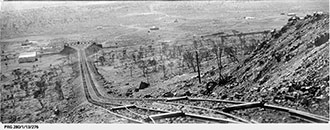
Rail track serving Iron Knob mine in South Australia
Courtesy SLSA [PRG 280/1/13/276]
Thevenard Express
PRG 280134132
The Willunga railway line was completed.
The Eyre Peninsula line was extended to Thevenard on 8 February 1915.
Initially, Grain haulage formed the primary railway traffic on the Eyre Peninsula. The other major commodity hauled was gypsum from the Lake MacDonnell deposits near Penong to the port at Thevenard. (See Penong on 1924 map).
The Gladstone to Wilmington line was completed, opening from Booleroo to Wilmington on 20 July 1915.
In 1915, shipments of iron ore began from Whyalla to BHP's newly-established Newcastle steelworks.
Thevenard Express at Cummins Station
SLSA B28023
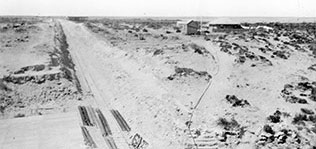
Thevenard Track
SLSA PRG280/1/12/99
Thevenard Jetty
SLSA PRG280/1/12/100
1917
A broad gauge track was built from Mt Gambier to Heywood near Portland in Victoria, creating a break of gauge at Mt Gambier.
Long Plains is on the developing broad gauge Adelaide-Port Augusta railway line, between Mallala and Bowmans. From 1917 to 1923 Long Plains was the rail terminus.
East-West rail link was a true nation-building success.
The first standard gauge line in SA was the Trans-Australian Railway running between Port Augusta and Kalgoorlie in WA, built by the Commonwealth Railways, and opened in 1917. Images of the work on this line can be seen under Galleries.
When opened in 1917, the Trans-Australian Railway carried passenger services, but to travel from coast to coast meant a route via Melbourne, and included about six train changes. It still runs today, travelling all the way to Darwin on the new standard gauge route to Alice Springs which opened in 1980, and on the extension to Darwin which opened in 2004.
The Returned Soldiers Settlement Act was passed, later replaced by the Discharged Soldiers Settlement Act in 1917.
The 1917 Act enabled the Government to reserve Crown land for discharged servicemen and to make loans for setting-up costs. Later, soldier settlers were given the right to purchase.
A branch was built from Balhannah to Mount Pleasant, from Riverton to Clare, and from Monarto South to Sedan
Railways of South Australia and New South Wales met at Broken Hill with a break-of-gauge.
The Silverton Tramway Co. provided a connecting line from Cockburn to Broken Hill and thus Port Pirie became a major port for the export of raw and processed minerals (lead, zinc and silver) from the mines of Broken Hill.
BHP ordered 2 additional locomotives from Baldwin, the 2-8-2s. These had almost twice the power as the 4-6-0 locomotives. The 2-8-2s locomotives were placed in service in 1920,and were then the most powerful in use in Australia. Though only 3’ 6" gauge, they could haul 2,000 ton trains unaided from Iron Knob.
The 4-6-0 locomotives were relegated to shunting, work trains, and banking empty ore trains up the 1 in 95 grade out of Whyalla
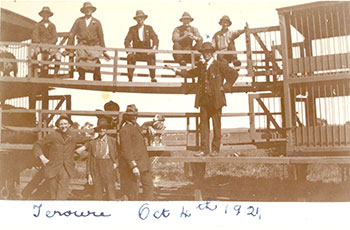
A new method for transferring sheep from narrow to broad gauge rail transport 1921
SLSA B-48873
The Clare line was extended to Spalding.
On Monday 3 Sep 1923 the Lochiel to Snowtown section of the Long Plains Railway was opened for traffic and Snowtown got a direct broad gauge connection from Adelaide. In 1923 this line terminated in Redhill.

Thursday 25 October 1923
COST OF BROAD-GUAGE TRUCKS
The cost per truck of the 100 broad guage tracks recently constructed by Perry's for the railway department was £442. The estimated cost per truck of making them suitable for the narrow guage by the Perry Engineering Company was £46 ; by chief mechanical engineer £41. These facts were ascertained by Mr. Blackwell questioning the Minister of Railways in the House of Assembly on Tuesday.
The Eyre Peninsula line was extended from Wandana to Penong on 7 February 1924
The Junction at Salisbury on the Gawler line was connected to Redhill and Angaston after the Long Plains line was completed to Redhill.
The Moorook/Yinkanie railway line opened to Yinkanie from Wanbi in 1925 on the Paringa line. It was proposed to later extend the line to Moorook and Kingston On Murray if demand arose, but road transport improved so the railway was never extended, and the line was closed on 1 May 1971.
The Eyre Peninsula line was extended from Kimba to Buckleboo on 5 August 1926.

10 September 1926
Broad Guage
After the meeting the Mayor mentioned the apathy of the ratepayers in the matter of the broad guage coming to Peterborough. Some move should be made to show the railways the urgent necessity of pushing on with this work, whereby the railways and Peterborough would be saved thousands of pounds every year, to say nothing of the other towns to Quorn. He was hopefull [sic] that a committee, outside the council, would be formed to go into the matter, but evidently the ratepayers were satisfied that it had to come and were prepared to wait until it was thrown at them and would take anything they could get.
Citizens are invited to attend ceremony of laying foundation stone of High School by the Premier on Friday next, Sept. 17th, at 3 p.m.
Broad gauge was laid from Hamley Bridge to Gladstone in 1927 to allow goods to be transported from Adelaide. Transhipping then became necessary to shift goods from the broad gauge to the narrow gauge wagons at Gladstone. Passenger trains to and from Adelaide were also introduced.
Yorke Peninsula lines were converted from narrow to broad gauge to connect to the line from Salisbury, along with the Hamley Bridge-Gladstone line.
On 1 August 1927, the Balaklava-Moonta line was converted from narrow to broad gauge. A junction at Kadina connected the Brinkworth-Kadina line.
The line to Paringa had been opened on 2 October 1913 but the intervention of World War 1 delayed the construction of the Paringa Bridge to extend the railway to Renmark until 1927. It later was also extended to Barmera with the first passenger service running on 1 August 1928.
The broad gauge Paringa railway line was extended over the Murray River to Renmark, Berri and Barmera
1928 A petrol-electric locomotive was purchased from the Davenport Locomotive Works, Iowa for use at Iron Knob.
In December 1935 an Act of Parliament (No. 2242 of 1935) was passed to approve an Agreement between the Commonwealth and State government to construct a railway line from Port Pirie to Port Augusta, via Red Hill, designed to shorten the time taken to travel between Western Australia and the Eastern States. By 1937, standard gauge stretched to Port Pirie from Port Augusta.
The Intercolonial Express, later known as the Melbourne Express, became The Overland in 1936. It was the first direct passenger service between two states without a break of gauge. When opened in 1917, the Trans-Australian Railway carried passenger services, but to travel from coast to coast meant a route via Melbourne, and included about six train changes. With completion of the east-west standard gauge project in 1970, a new direct service became known as the Indian Pacific, but it took until 1986 before the Indian Pacific operated via Adelaide.
1937: Trans-Australian Railway extended to Port Pirie Junction and the broad gauge railway from Adelaide to Redhill extended to Port Pirie, Ellen Street (right through the middle of the town).
By the mid 1930s B.H.P. had either begun mining or pegged leases at, Iron Baron, Iron Queen, Iron Prince, Iron Duke, Iron Knight and Iron Duchess, all to the south of Iron Knob.
In 1930, a branch line opened from Middleton Junction to Iron Baron and the Iron Baron mine opened in 1933.
The Iron Baron mine is one of several large orebodies in the Middleback Range, with a production capacity of about two million tonnes of haematite a year. Built by BHP in 1933, it went out of operation between 1947 and 1958; it was re-opened in 2011.On-site facilities now include a fully functional ore beneficiation plant.
The Iron Baron settlement was situated about 200 metres from the eastern boundary of the mine. BHP owned and serviced the settlement, having built it about 1938.
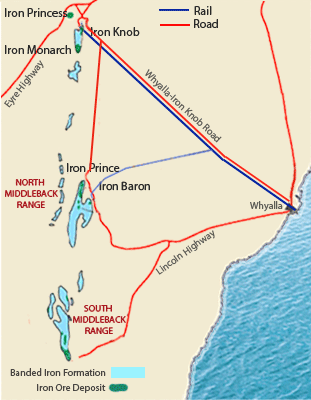
Map showing Rail Tracks in 1930
A branch on the Eyre Peninsula Line, from Kevin to Kowulka, opened on 11 April 1950
An assisted migration scheme brought 215,000 emigrants of all nationalities to South Australia between 1947 and 1973.
A blast furnace was opened at Whyalla in 1941
The branch line to the Iron Baron mine closed when the mine went out of operation between 1947 and 2011.
Many of the steam locomotives used on the tramway were transferred from BHP's Broken Hill operations. By 1941, the fleet comprised 12 locomotives.

Mount Gambier
Thursday 5 December 1946
BROAD GAUGE RAILWAY
Shortage Of Rails Hinders Work
The broadening of the railway gauge in the South-East between Wolseley, Mount Gambier, and Millicent had been retarded because it was impossible to obtain the necessary rails from the B.H.P., said the Minister of Railways (Mr. Mcintosh), in reply to Mr. Corcoran (A.L.P.) in the Assembly on Monday.
The original plan was to rebuild the line in two and three-quarter years.
All States were being severely rationed with rails, and the position would not be remedied until more coal was available. Eighty men were engaged on the work, but 400 were necessary.
With the development of the Leigh Creek Coalfields in the early 1940s, it was decided to construct a railway linking the coalfields with Port Augusta, in 1950 and from Leigh Creek to Marree in 1954.
The construction of a standard gauge line from Leigh Creek to Port Augusta and therefore further south, allowed Leigh Creek to be the principal supplier of brown coal for the electricity needs of South Australia.
This line opened on 17 May 1956 from Stirling North on the outskirts of Port Augusta to Telford Cut and on 27 July 1957 to Marree to connect to the volume of cattle traffic coming off the Birdsville Track, all replacing the narrow gauge line on a route west of the Flinders Ranges
After 13 August 1956 the 'Ghan' therefore ran from Port Augusta to Alice Springs via Marree, where there was a break of gauge and passengers changed trains back on to the narrow gauge line to continue to Alice Springs.
During the 1950's DH and DE class diesel locomotives replaced the steam locomotives at Iron Knob.
In 1956 Locomotive No. 5 was written off and scrapped but No. 4 was fitted with special steam pipes to enable it to drive the Company’s pile driver. It has now been refurbished to display standard and was placed at the Mile End Railway Museum on 11th November 1988.

Locomotive No. 4 Peronne
Courtesy Douglas Colquhoun Collection, National Railway Museum
The Mount Pleasant railway line was closed in 1964, and is now Amy Gillett Bikeway.
By the mid 1960's with the traffic potential of the gypsum deposits being realised it was decided to construct a new 37 mile (59km) line leaving the Thevenard line one and quarter miles (2kms) south of Ceduna and running direct to Kevin. This line was opened on 13 February 1966.
In addition to the tramways based on Whyalla, BHP also operated a standard gauge line from Port Lincoln to the limes and deposits near Coffin Bay. This line opened in 1966
1958 a branch from Middleton Junction to Iron Baron reopened
1960 A full steelworks was built at Whyalla in the early 1960s and the internal Whyalla Steelworks network was converted to standard gauge to allow large 200 ton capacity torpedo ladles to be used.
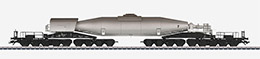
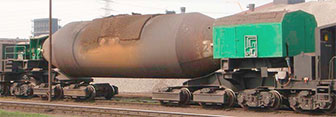
Torpedo Ladle
The rail car passenger service to Moonta and to Brinkworth ceased in 1968.
The Barossa lines from Gawler railway station closed to passengers on 16 December 1968 beyond North Gawler railway station, but freight continued until 2014. North Gawler is now Gawler Central in the metropolitan network.
With the conversion of the Port Pirie to Broken Hill line from narrow to standard gauge in 1969, the Wilmington line became an isolated narrow gauge railway and passenger services ceased.
In 1970, the narrow gauge Port Pirie to Cockburn line, and the 56km privately run link through to Broken Hill was replaced by a standard gauge line.
With completion of this east-west standard gauge project in 1970, a new direct service became known as the Indian Pacific, but it took until 1986 before the Indian Pacific operated via Adelaide.
The Willunga railway line closed in 1969 and is now the Coast to Vines Rail Trail.
The Strathalbyn line was formally closed on 17 June 1970. The route is now a "rail trail" that is popular with hikers.
Terowie to Peterborough was opened to broad gauge in 1968 but not closed to narrow gauge until 1970, being officially dual gauge for 18 months.[Reference]
Once standard gauge connected Port Pirie with Broken Hill, triple gauge stations were created at Peterborough and Gladstone.
1970s Iron Prince and Iron Queen mines opened
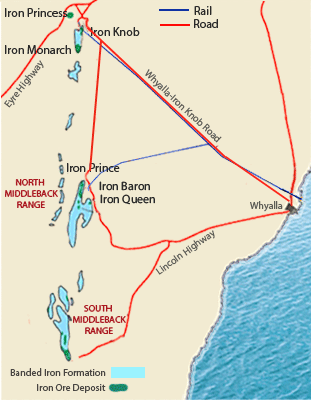
Map showing Rail Tracks in 1970
The standard gauge Whyalla railway line opened from Port Augusta when standard gauge trains from interstate accessed the steelworks.
The Tarcoola to Alice Springs standard gauge railway opened, the first stage of the Adelaide–Darwin railway.
The first Ghan on the new line departed Adelaide on 11 December 1980. It initially operated as a broad gauge service to Port Pirie. Following the conversion of the Adelaide to Crystal Brook line to standard gauge in 1982, it operated as a standard gauge train throughout.
The Ghan to Alice Springs, named after the cameleers who provided much of the early transport throughout the arid interior, began on the old narrow gauge line to Oodnadatta in 1929. It still runs today, travelling all the way to Darwin on the new standard gauge route to Alice Springs which opened in 1980, and on the extension to Darwin which opened in 2004.
Passenger trains to Port Pirie ceased in the early 1980s
The Adelaide to Crystal Brook standard gauge railway opened to replace the broad gauge line from Salisbury to Port Pirie, thereby connecting Adelaide to the standard gauge network.
The tracks through Port Adelaide station were dual gauge from 1982
The section from Kadina to Snowtown was converted to dual gauge on 2 December 1982.
The section from Balaklava to Paskeville (outside Kadina) closed in 1984, followed by the Wallaroo to Moonta and Wallaroo to Kadina sections.
After the railway closed, part of it was used by the Lions Club of Yorke Peninsula Railway for heritage tourist services, but this ceased operations in 2009.
Eurelia-Quorn was closed on 3 March 1987
Hallett-Peterborough was closed on 26 July 1988
Peterborough-Eurelia was closed on 22 November 1988
Gulnare-Gladstone was closed on 11 May 1988
The Gulnare section was closed on 29 March 1989
The section of track between Balaklava and Gladstone was removed in late 1989 and the 10 km section between Halbury and Balaklava has now been converted into the Shamus Liptrot Cycling Trail.
Operations ceased in 1989 from Port Lincoln to Coffin Bay and the line was dismantled in 2001.
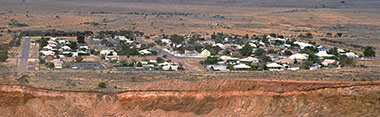
Iron Knob from the main mine site in 1988.
Courtesy Iron Knob Tourist Centre
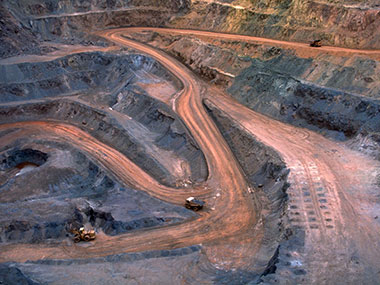
Iron Knob main mine site in 1988.
Courtesy Iron Knob Tourist Centre
The Snowtown to Brinkworth line closed on 20 February 1990.
The Whyalla branch of Adelaide-Darwin railway from Port Augusta closed 31 December 1990.
The Paskeville to Kadina section closed on 14 March 1990.
The Wilmington line closed on 13 March 1990.
Burra-Hallet was closed on 14 November 1990
Robertstown line was closed on 25 November 1990
In 1990 the Iron Duke mine opened 55kms south-west of Whyalla off the Lincoln Highway.
The mainline is 76kms to Iron Duke. Trains are made up of two locomotives hauling 50 trucks each carrying 60 tonnes of ore - a total of 3,000 tonnes each. Up to four trains per day can be loaded depending on plant requirements.
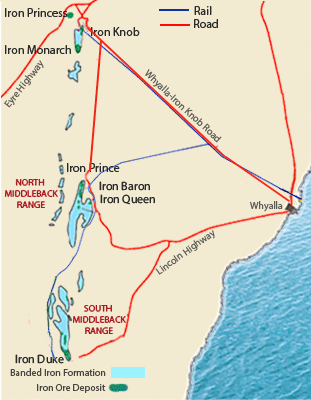
Map showing Rail Tracks in 1990
1991 iron ore production ceased at Iron Baron, but this was not permanent.
Kadina-Snowtown was closed on 3 March 1993
Kadina-Wallaroo was closed on 3 March 1993
Kapunda-Eudunda was closed on 11 March 1994
The South Australian Railways' Mount Gambier line from Wolseley to Mount Gambier and associated branches were converted to broad gauge in the 1950s, on the understanding it would change again to standard gauge at a later date, which would have made it the first and only railway in Australia to have successfully been converted to all three gauges. However it closed in 1995.
May 1995.It was announced that the line west of Pinnaroo would be converted from broad gauge to standard gauge.
1996 The main line to Alawoona and only remaining branch to Loxton closed on 6 January 1996 to be converted from broad gauge to standard gauge in order to retain connection to the main line from Adelaide to Melbourne after that line was converted.
Work on the conversion of the line west of Pinnaroo was delayed following a large grain crop and increased traffic by trains destined for regional Victoria on the broad gauge network. A small part of the line, converted in 1996, was converted back for the grain harvest in 1997. To continue the journey to Adelaide, the grain was transhipped at Tailem Bend.
2 July 1998 The last broad gauge train operated through Pinnaroo.
25 November 1998 The Pinnaroo-Tailem Bend line reopened as standard gauge but as the Victorian line remained broad gauge, Pinnaroo remained broad gauge and became a break of gauge point.
The main line through Karoonda remained open until 2015 as the Loxton railway line and was converted from broad gauge to standard gauge.
The last grain train from Kevin to Penong operated on 3 March 1997.
Please refer to the Article on the "Iron Mines & Tramways: Middleback Ranges to Whyalla" in the ARTICLES Menu above for a history and maps of this complicated area.
Viterra announced that no more grain would be carried by rail after 31 July 2015, with the 2015 harvest to be entirely transported by road.
The Pinnaroo line closed in July 2015.
The Barossa line from North Gawler, which had closed to passengers on 16 December 1968, closed to freight in 2014. North Gawler is now Gawler Central in the metropolitan network. NB Gawler Central was closed between 2020-2022 for electrification. (Not shown on the maps.)
The Loxton line closed on 20 July 2015
The line that Karoonda is on is now suspended indefinitely.
On the 3rd of March 2023, Aurizon and Viterra submitted a formal application to the Australian Federal Government for A$220 million in funding to repair and upgrade the Eyre Peninsula Railway lines. The proposal includes re-opening the Port Lincoln-Wudinna and Cummins-Kimba lines, upgrades to the outloading facilities at Viterra’s Lock, Wudinna, Cummins, Kimba and Rudall sites with a target of at least 1.3mt of grain to be hauled by rail per year. Aurizon and Viterra plan to have the network reopened within 12 months if funding is approved
2021 After a five-year gap, trains carrying export iron ore resumed running to Whyalla in South Australia as strong market demand drove spot prices to a record level.
ARRIUM Mining railed the first shipment of iron ore out of Iron Knob since the late 1990s.
2022. The 2000 ASR contract was included in the sale of OneRail Australia, as ASR had become, to Aurizon.
The Iron Sultan mine was approved and would develop a hybrid pellet feed plant to significantly reduce the price of making steel at the Whyalla blast furnace
The Iron Warrior mine was approved and will produce up to 1.5 million tonnes of export iron ore annually.
The road between Eudunda and Kapunda